
Criminal Cases in the Lee County Courts
Lee County felonies, misdemeanors, ordinance cases, and state traffic matters are filed in Iowa District Court. Iowa does not use a separate city municipal criminal court. A citation from Fort Madison, Keokuk, or West Point therefore enters the same unified trial-court system, while a city parking matter stays with the city. The court file begins when a prosecutor files a charge. It records what was formally alleged, not just what an officer listed at arrest.
The clerk is the custodian of the Lee County case file. Docket entries can identify the parties, attorneys, filed charge, hearings, orders, plea, outcome, sentence, and money due. The County Attorney prosecutes, but that office is not the public court-record counter. The State Public Defender may represent a qualifying defendant, yet it is not a general records custodian either. For the actual docket and filed papers, use Iowa Courts Online and the clerk location tied to the case.
Lee County's Two Court Locations
Lee County is Iowa's only county with two county seats. The arrangement is more than a mailing quirk. An Iowa Supreme Court history of the two venues traces court sessions in Fort Madison and Keokuk to an 1848 act, and state law still requires court at both seats. A name search can locate the docket, but the physical file, certified copy, or older Lee County court record may remain with one clerk.
North Lee Clerk
701 Avenue F
PO Box 1443
Fort Madison, IA 52627
319-372-3523
Fax: 319-372-2557
South Lee Clerk
14 South 5th Street
PO Box 725
Keokuk, IA 52632
319-524-2433
Fax: 319-524-4699
Ask which location holds the case before seeking paper, restricted, historical, or certified material. That one call can prevent a trip to the wrong side of Lee County.
How to Search Case Records
Iowa Courts Online is the main public search channel for Lee County criminal court cases. Its free docket covers public trial cases after 1998 and some earlier data. An exact Case ID is the cleanest route. A name search can work when the spelling and other identifiers are sound.
- Open Iowa Courts Online and select the trial-court search that fits the identifier you have.
- Choose Lee County, then enter an exact Case ID or a name with at least two letters in each required name field.
- Use the exact date-of-birth search or add middle-name detail when a common name produces too many results.
- Open the blue Case ID and read the charge, filing events, disposition, and financial entries as separate parts of the record.
- Contact the correct North Lee or South Lee clerk for a public document, copy, certification, or pre-1998 file.
| Search field | Required | Format | Use |
|---|---|---|---|
| Last or firm name | Yes for name search | Two letters minimum; % wildcard allowed | Starts a party-name query |
| First and middle name | First is conditional | Do not add a period after an initial | Narrows similar names |
| Exact date of birth | Yes for DOB mode | Must match the exact date | Distinguishes people with the same name |
| County and case type | Yes for Case ID mode | Select Lee and a portal case type | Localizes the search |
| Case ID | Conditional | 17 characters; capitalize letters | Opens one known case |
| Citation number | Alternative | Enter the exact citation | Finds the related court entry |
The official Iowa ePayment search also shows name and case-or-citation search paths.
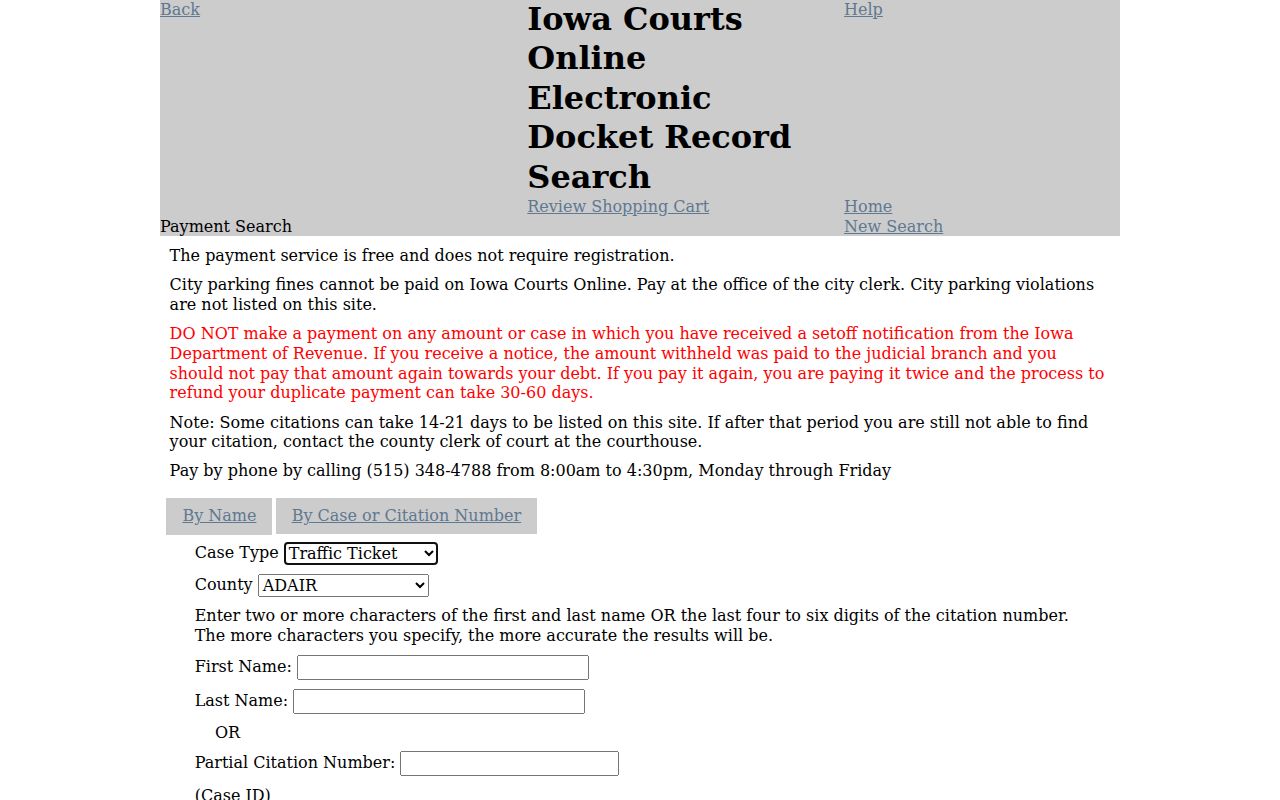
The captured screen helps a Lee County searcher choose between a broad name query and a known case or citation number.
Lee County Court Search Tiers
Three access levels serve different needs. The free docket is best for finding a Case ID and reading core events. Advanced Case Search registration costs $25 per month and adds schedules, judgments and liens, exhibit lists, service returns, full financial data, and traffic details. It does not deliver remote document images. A free public terminal at the courthouse where the case was filed provides access to public documents that are not available from the web docket.
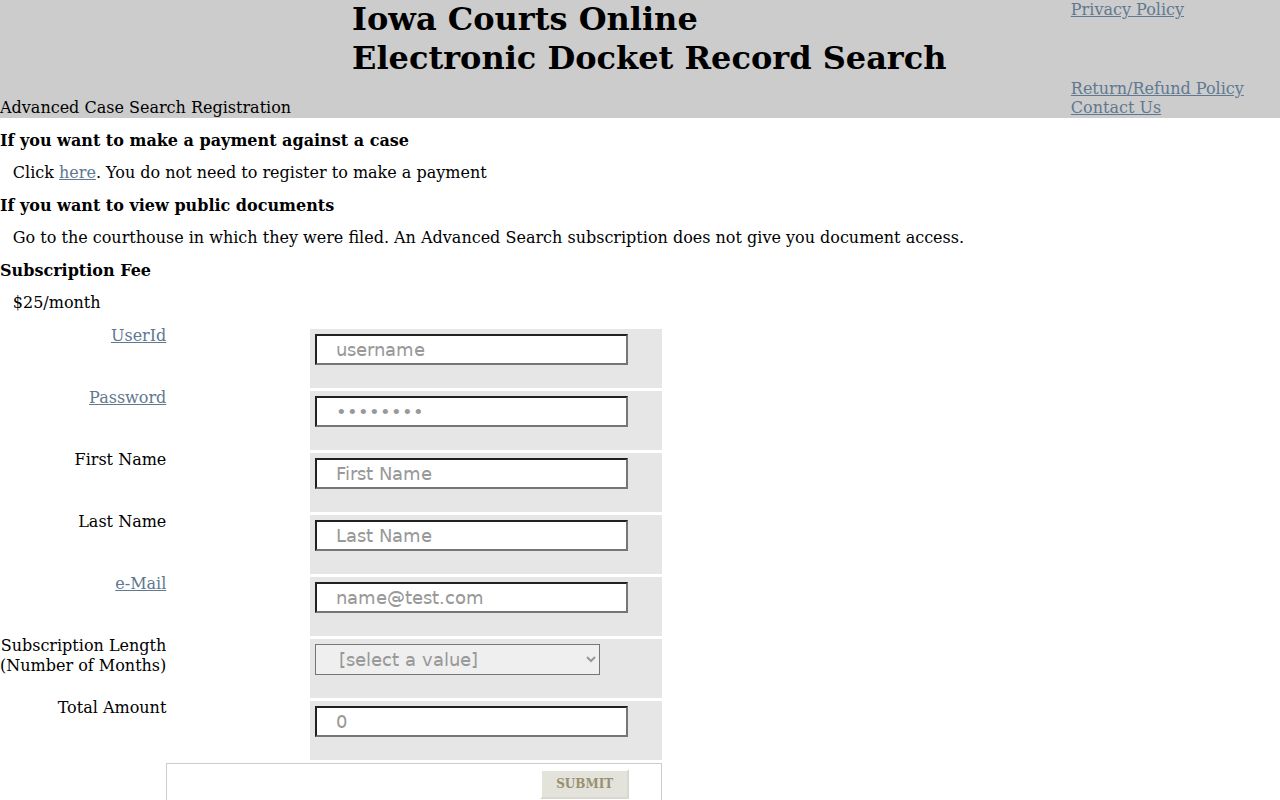
The subscription screen confirms that added metadata and remote copies are separate services. Public-copy guidance lists 50 cents per page, with possible charges for supervised examination or special service.
Note: Paying for Advanced Case Search does not unlock scanned pleadings, orders, or every restricted Lee County court document.
What the Case File Shows
A Lee County court file separates allegations from outcomes. The title and charge rows describe what was filed. Later docket events show motions, hearings, amended counts, pleas, and rulings. The disposition and judgment establish how a count ended. Financial entries can track fines, fees, restitution, sums paid, and balances. Availability varies by free docket, subscription, and courthouse-terminal access.
| Case ID and court | The unique file reference, case type, county, opened date, and indexed judge. |
|---|---|
| Parties and lawyers | Names, roles, status, and counsel connected to the case. |
| Charge entries | Count, state or city code, description, defendant, and later outcome. |
| Docket events | Filed item, event date, filer, comments, status, and update history when public. |
| Disposition and judgment | The result for each count, which may differ from the original filed charge. |
| Sentence and money | Public sentence terms plus fine, surcharge, restitution, payment, and balance fields. |
| Bond data | Set or posted sum, type, dates, agent, forfeiture, release, and service information when available. |
A court record is not a DCI rap sheet. DCI may retain a fingerprint-supported arrest cycle even when the Lee County docket later shows dismissal or a discharged deferred judgment. Compare the disposition row with the underlying filed order before drawing a conclusion.
Lee County Case Timing Gaps
A newly filed Lee County case ordinarily takes about one business day to enter Iowa Courts Online. Citations can take 14 to 21 days. A missing result during those windows does not prove that no charge or citation exists. Check the spelling, try the exact citation or Case ID, and then call the relevant clerk if the expected event still does not appear.
Charge and disposition are also separate in time and meaning. An arresting officer records an intake allegation. The County Attorney decides what to file. The court later records the plea, ruling, dismissal, acquittal, or conviction. Reading only the first charge row can miss an amendment or final outcome. For a broader account of the intake stage before filing, use the contextual Lee County arrest history resource.
Stages of a Criminal Case
The public file grows as the matter moves. A prosecutor first files one or more charges. Arraignment records the plea and starts the formal schedule. Pretrial entries may show motions, orders, discovery events that are public, and hearing dates. A plea or trial resolves the contested charge. The court then records a disposition for each count and, after a guilty outcome, the sentence and financial obligations.
Case flow: Charges Filed → Arraignment → Pretrial → Plea or Trial → Disposition → Sentencing
Not every Lee County case uses every stage. A dismissal can end the file before trial. A plea can combine disposition and sentencing in a short span. The docket sequence, not a generic timeline, shows what happened in the specific matter.
Lee County Court Record Custodians
The County Attorney has offices on both sides of Lee County and handles prosecution, victim-witness work, and collection duties. Its two-office structure reflects the same local geography as the courts. The official Lee County Attorney source identifies the South office at 25 North 7th Street in Keokuk and the North office at 710 Avenue F in Fort Madison. Do not confuse the North prosecutor at 710 Avenue F with the North Lee clerk at 701 Avenue F.
The State Public Defender Burlington office serves the region from 216 South Third Street in Burlington and can be reached at 319-753-5163.
That office is a defense service, not a source for general Lee County docket copies. Represented people should communicate about their case through counsel.
Access & Restrictions
Iowa's open-record framework does not make every Lee County court paper downloadable. Iowa Code chapter 22 governs public records, while court rules identify protected documents. Presentence investigations, confidential juvenile matters, protected victim information, and sealed material stay outside ordinary public access. Unexecuted search or arrest warrant applications, orders, and related information are restricted until execution and return or initial appearance, whichever comes first.
A blank web result can reflect a timing gap, a confidential case, a restricted document, an old file, or a search mismatch. It is not proof that no Lee County case exists.
Ask the clerk about the exact case and product needed. Public documents can be viewed without charge at the terminal where filed. Copies and certification go through the correct clerk. Most juvenile information remains confidential under Iowa Code §232.147, and a private release does not override that rule.
Lee County Historical Case Files
Free Iowa Courts Online coverage centers on trial cases after 1998, though some earlier entries appear. If a Lee County criminal case predates that period, begin with any name, date range, charge, location, or old case reference you have. Then call the North Lee or South Lee clerk. The dual-seat history makes venue confirmation especially important for paper and archived records.
Do not assume the closest courthouse holds the file. Older practice divided criminal work by city and township, and the two-seat system still matters under Iowa law. A clerk can confirm whether an index entry exists, where the file sits, and what copy or inspection path applies. Specific parking, screening, device, and accessibility-counter details were not published in the reviewed official sources, so confirm those points before visiting.